
Julian Pensky

There are a huge number of prominent representatives of the art, science, politic and other areas of activities who are always on everyone’s lips. Their deeds are discussed at scientific conferences, in meeting rooms and in research papers. But today we are going to talk about a representative of one of the noblest professions: about a doctor, an ethnic Pole, and just a worthy person – Julian Pensky. Before beginning his story, it is worth to mention those people who invested in him the eagerness and power with which he got through the life.
Julian was born in 1859, in the town of Slavuta (now – Khmelnytskyi region) in a Polish family. His native father, Roman Pensky, participated in the January Uprising (1863-1864), that is why he was sentenced by tsarism to exilement in Siberia. As a result, little Julian, who was only four years old at the time, had to grow up without a father. The mother of our hero, Henrika, often told him about Roman Pensky, always taught him to be strong and persistent, and pursue the goal. Julian’s childhood was spent in Slavuta. Although it was difficult for the young boy to live without his father, he became gradually successful and promising. In the late 1870s, Julian Pensky came to Kharkiv, pursuing only one goal – to gain knowledge and a decent education. As a result, in 1872 Julian Pensky enrolled in the Kharkiv High School, where he studied until 1876. After that, he decided to narrow down the circle of his education, choosing one specific area – surgery.
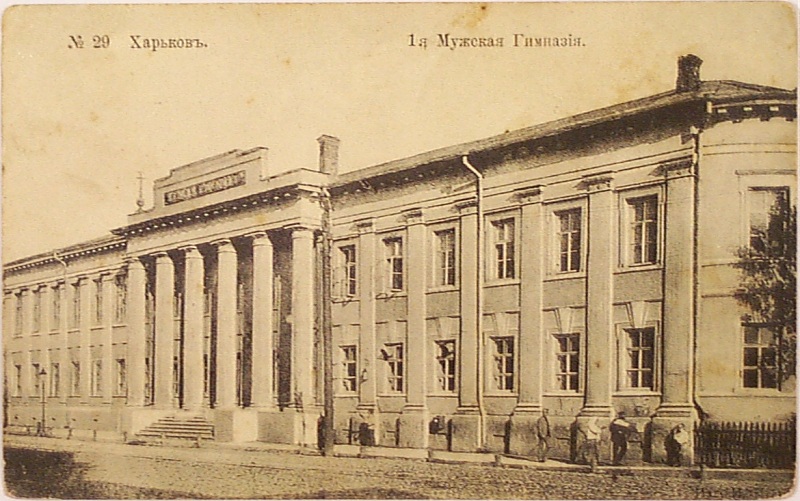
After that Julian started to learn more carefully, for his chosen professional career required it. Already in high school, the future surgeon knew well what to do next. In order to accomplish all his ideas and desires, he prepared for the lessons extremely carefully and honestly. The efforts of Julian Pensky gave the necessary result: after a brilliant graduation from the Kharkov High School (1880) he entered the Kharkiv University without hesitation. After all, Julian not without reason considered it the most suitable place to improve his knowledge. Since then, his life changed dramatically. The hero of our essay spent the first two courses in the library of the University, without losing the opportunity to attend it after each lesson. The future eminent surgeon did not know at the time that through his hard work in his student years he would later be able to become a professor, who would alleviate the suffering of thousands of people through his discoveries.
At the end of the second year he showed great success in his studies. The youngster studied easily, gaining experience and, what is more important, acquiring permanent mentors who were able to see his potential.
In the following courses, teachers taught Julian the theory and practice of medication composing. At the same time, the talented student quickly learned everything related to surgery. Among other things, he then worked in the laboratories of professors A.I. Jacobia and V.P. Krylov, what gave him invaluable knowledge in the field of hygiene and pathological anatomy. By the end of his studies, Julian Pensky almost lived in the university, studying all day long and trying to absorb everything that had to do with the advanced course of surgery. In this regard, he was most concerned with the ways in which cells damaged by trauma or postoperative surgery can be restored. It awoke in him at times still unrefined, but extremely bold ideas.
The end of his studies at Kharkiv University was only a formal transition from one plane of the study of surgical procedures to another. It should be noted that the final exams turned out to be just childish entertainment for Julian Pensky. In the archives of the university there is an evidence that in 1885 he graduated from his alma mater with the notation “Cum Eximia Laude”, i.e. “With great honor”. Few people used to reach this level. In the best case scenario, students were getting “Cum Laude” which means simply “With honor”.
Already prepared for great achievements, 27-year-old Julian became a prosector assistant. In this position, he undoubtedly came in handy for those extracurricular classes with teachers of Kharkiv University, which provided the talented student with additional knowledge of the theory and practice of creating medication and drugs. For nine years, Julian gained experience working side-by-side with his mentor, a prosector doctor. The latter conveyed to the inquiring student the knowledge in practice, indicating where exactly it can be used for their benefit and even further improved. It can be said that after five years of such work, Julian Pensky could hardly be called an “assistant”. After all, the peer educator treated his subordinate as an equal, recognizing his high professional level. Through this work, the hero of our essay got not only experience, but also the necessary recommendations for further career.
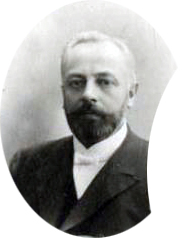
In 1893 he defended his scientific work for the degree of Doctor of Medicine (on the topic “Transplantation Experience”). From 1895 Julian Pensky became a prosector too, with the notation “specialist in surgery”. On the 25th of May of that year, he was approved by the “highest order” as a professor in the Department of Operative Surgery and Topographic Anatomy. From now on, he could work to the fullest in his favorite area of scientific interest, perfecting the practice of suturing both external and internal damage to tissues and organs. At the same time, Julian Pensky actively promoted science. In 1896, in parallel with his main work, he became an editor of the magazine “Publications of the Medical Section of the Society of Experimental Sciences” and an employee of the periodical “Herald of Medicine”. In the late XIX – early XX centuries, Julian Pensky actively contacted with another surgeon, N.M. Kuznetsov, in a professional capacity. Their scientific interests were completely the same.
In 1909, Julian Pensky entered a new quality level in his career, heading the Department of Hospital Surgery at Kharkiv University. This position became his place of employment until his death; he never stopped his professional activity even for a minute. Pensky headed the department and continued to work with Kuznetsov (their collaboration started in 1893). For two years, they were working on a modified version of the sutures of extremely affected internal organs (primarily focusing on liver suturation). This hard work yielded results that would be successfully used in medicine for over 100 years. The Pensky-Kuznetsov hemostatic suture is still well known to any experienced surgeon. In parallel, Julian Pensky improved some of the recommendations for the treatment of diseases of liver and internal organs of the body.
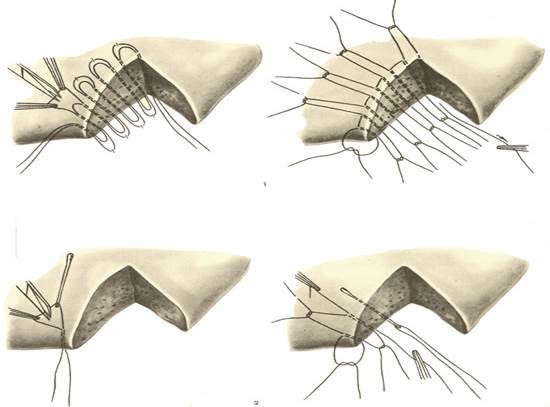
Pensky and Kuznetsov decided not to dwell on the invention of such a new and “revolutionary” system of treatment at that time. A tandem of prominent surgeons was refining ways to treat and regenerate the liver. They proposed the Pensky-Kuznetsov needle, thereby creating a new method of liver resection and refining the earlier invented effective Pensky-Kuznetsov suture. This helped to alleviate the fate of thousands of people for over 100 years. Therefore, the prominent Pole was not afraid to offer the new and cast away the ineffective and obsolete.
Julian Pensky had the chance to tell about his thoughts and scientific achievements at the XII Congress of Surgeons (1912), where he made a report on the early operation of acute appendicitis. This case once again confirms the wide range of professional interests of the prominent physician. What can be said for sure: he was not afraid to work both individually and in a team. Undoubtedly, Julian Pensky was a sensible person, and therefore he realized that only by combining their knowledge different scientists can create something truly revolutionary together. In 1914, he was the first to perform a pericardiotomy of adhesive pericarditis. This operation was performed by the hero of our essay together with another specialist in the field of surgery – Trofimov. Another important achievement of Julian Pensky was the invention of an artificial bladder, which he used to construct successfully from the bowel loop during real operations.
The last years of this distinguished physician’s life proved to be extremely productive from a professional point of view, but they were difficult. The Revolution of 1917, the Civil War, and the frequent changes of power – all of this extremely hindered activities of his faculty and of the university as a whole. In 1919, his alma mater was informed that the university would be reformed at the request of the People’s Commissariat for Healthcare of the Ukrainian SSR. And in April 1920, Julian Pensky died at the age of 60.
The life story of this eminent surgeon clearly proves that the perseverance and strong character is the prerogative of only great men. Nowadays, Kharkiv people remember Julian Pensky well. For example, Kharkiv National Medical University recently celebrated his 150-th anniversary. Doctors honored the memory of this famous physician as an unsurpassed example of mercy and human decency and an extraordinary personality who dedicated his entire life to finding ways to facilitate the destiny of others.
Sources of information:
1. Малая медицинская энциклопедия. – Москва, 1991-1996.
2. Перцева Ж. Последний декан медицинского факультета // Медичний університет. – 2019. – № 3-4 (28 лютого) – С. 5. [Електронний ресурс]. – Режим доступу: http://www.knmu.kharkov.ua/attachments/3-4_19.pdf
3. Ziemia Sławucka – ojczyzna znamienitych Polaków. Część 2 // Słowo Polskie. – 2019. – № 10/87 (październik).
4. Szarejko P. Słownik lekarzy polskich XIX wieku. – Tom 4. – Warszawa, 1997. – S. 222-224.
Prepared by Maksym Agarkov